
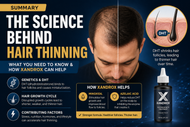
The Science Behind Hair Thinning: What You Need to Know (And How Xandrox Can Help)
Posted by Xandrox on 4th May 2026
Hair loss may be something most individuals have encountered at some point, but not many know much about it. Initially, it may seem as though it's just an additional strand or two on the pillow, but eventually, things begin to get more noticeable. Fortunately, through advances in science and technology, it's easier than ever before to understand why hair loss occurs, and more importantly, how it can be treated.
So let's get straight to the point.
The Hair Growth Cycle
Each individual hair that grows on your head undergoes a normal hair growth cycle, which consists of three phases:
- Anagen: During this phase, your hair grows actively. It may take many years.
- Catagen: It is the transitional phase, during which hair growth slows down, and the follicle becomes smaller.
- Telogen: Hair stops growing and falls off to allow new hair to grow.
Hair loss occurs when the hair growth cycle gets interrupted, particularly when the anagen phase gets shorter and more hair enters the telogen phase prematurely.
The Real Enemy: DHT
Pattern baldness or hair thinning happens because of a chemical called dihydrotestosterone or DHT.
DHT comes from testosterone and helps carry out essential bodily functions. However, in those with genetically predisposed sensitivity to DHT, DHT binds to hair follicles causing miniaturization, or shrinkage.
As time passes, people with genetic sensitivity will:
- Grow back weak and fine hair
- Slow growth rate
- And eventually, stop growing hair completely
For this reason, pattern hair loss always tends to follow certain predictable patterns, such as thinning on top of the head or receding hairlines.
Why Do Genetics Play Such an Important Role?
Everyone reacts differently when exposed to DHT. It depends on one's genetic makeup how sensitive to DHT their hair follicles are.
This means that:
- Some will retain their thick hair even into their 70s and 80s
- While others will start losing hair in their 20s, even their teens
In addition, if hair thinning runs in your family history, chances are you may be more prone to it.
Other Hair-Thinning Accelerators
Besides DHT, other factors that could exacerbate your condition include the following:
- Stress: Causes hair to shed before its time
- Malnutrition: Lacks iron, proteins, and vitamin D
- Hormonal disorders: Such as thyroid conditions or menopause
- Medications and illnesses: Could disturb growth patterns
These may not necessarily lead to hair loss, but they could accelerate thinning in people who are predisposed to it.
Treatment Methods for Modern Hair Loss Problems
The most effective methods of treating hair thinning involve:
- Encouraging hair growth by enhancing follicles' capabilities
- Inhibiting DHT's action on the scalp
Among the most common treatment methods include:
- Hair growth stimulants: Minoxidil
- DHT inhibitors: Finasteride
Where Does Xandrox Stand?
Xandrox is an external treatment that aims to fight hair loss on various fronts.
1. Minoxidil: Promoting Hair Growth
The key ingredient in Xandrox is minoxidil. Its role includes:
- Prolonging the growth stage of hair
- Improving circulation in the scalp area
- Promoting the growth of thicker and longer hair
It is one of the best scientifically backed ingredients for hair regrowth.
2. Azelaic Acid: Fighting DHT
Azelaic acid is another important ingredient found in some Xandrox products. It might be able to:
- Decrease the function of the enzyme responsible for turning testosterone into DHT
- Directly reduce DHT concentrations in the scalp
Even though its effect isn’t as powerful as medications, it provides a valuable supplement.
3. Other Ingredients
In addition, some varieties of Xandrox contain:
- Anti-inflammatory components for soothing irritation in the scalp area
- Substances that enhance skin penetration of the product
What Can You Expect from Xandrox?
Well, Xandrox is no wonder drug but, in some cases, it proves to be efficient if used continuously.
You might experience:
- A slower pace of hair loss
- Some slight thickening of hair
- Greater density of hair where it's lost the most
The efficiency depends, however, on:
- The stage at which the treatment started
- Your genetic predisposition to DHT
- Whether you use it regularly (it's very important)
The process of hair thinning is triggered mainly by hormonal and genetic processes, as well as disrupted cycle of hair growth. It's beyond your power to change your genetics, so here's what you can do to slow down hair thinning.
Xandrox combats the problem in two ways:
- Stimulation of hair growth due to minoxidil
- Possible inhibition of DHT due to azelaic acid
With continuous use, the medication can help prevent hair loss and increase hair density.
The first step to success is early treatment and continuous application.